
Many fully branded communities. One platform underneath.
White-label tenancy, a five-tier permission ladder, per-office scoping and real usage analytics — so you run your own community, with your own brand and governance, without raising a ticket with us.
Your brand · your domain · your governance
 Cynthia
Self-service where it matters. Locked where it should be.
Multi-organisation platforms fail in one of two directions — everything funnels through the vendor, or clients get keys to the whole building. This does neither.
Instant branding
Your own subdomain or vanity domain, your name, colours and light and dark logos. The whole portal reskins at boot, and auto-contrast keeps any brand colour readable everywhere.
Modular features
Every capability toggles per community, with dependencies resolved automatically and enforcement on the server rather than just in the UI. Features carry their own settings too.
A five-tier role ladder
Super Admin, Owner, Admin, Manager, Agent. Promotion is authority-bounded — you can only grant roles below your own, in communities you administer.
Market centres
Subdivide a community into offices and scope content, rosters and public directories to each. Untagged content still shows everywhere.
Usage analytics
What members actually do — listings created, links shared, leads received, reports generated — as an overview, a per-agent filter and a leaderboard, plus full AI cost tracking.
Your own legal documents
Publish your own privacy policy and terms on your branded routes; communities that do not provide their own inherit the platform defaults.
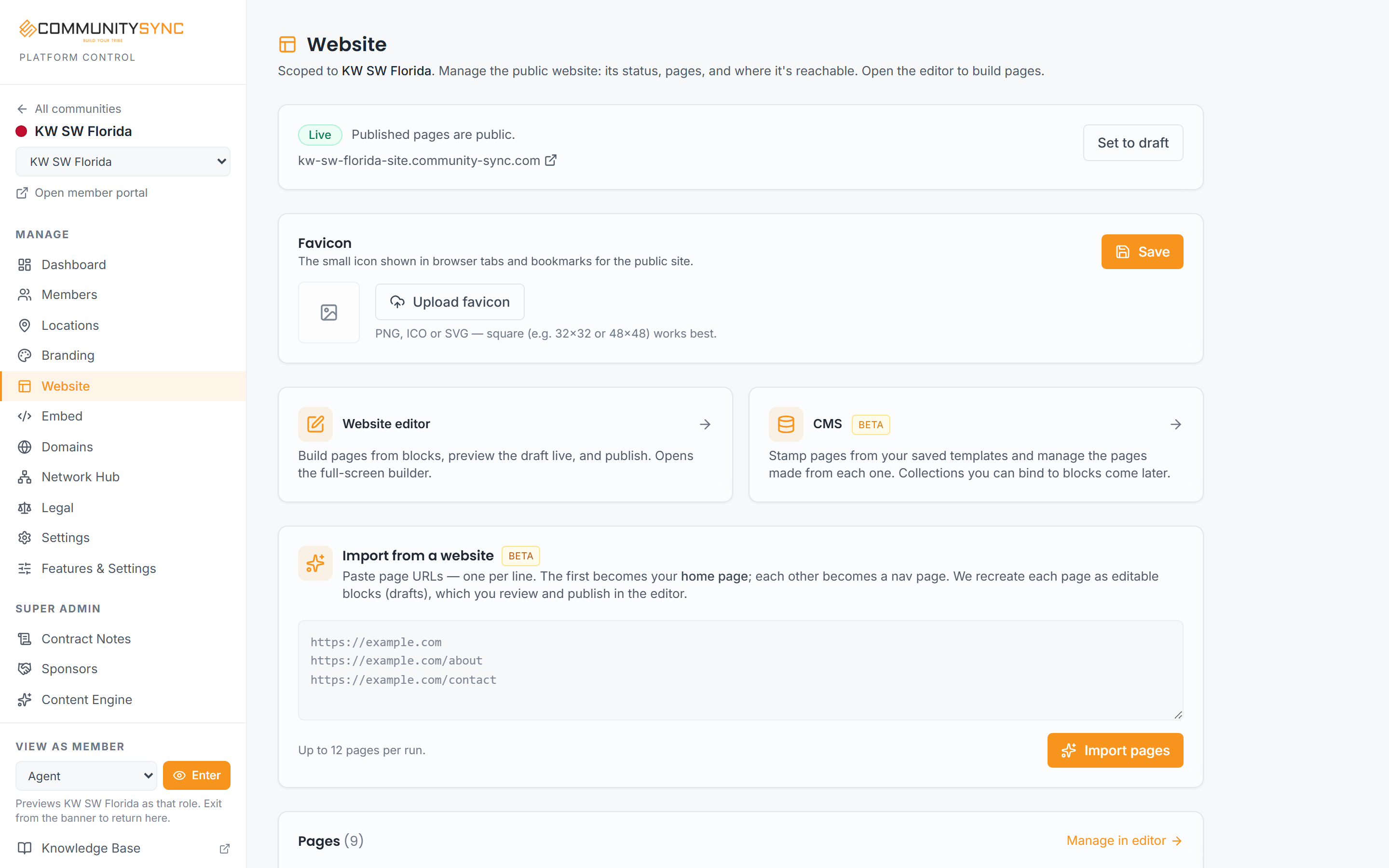
Your members never see our name.
The usual version of "white label" is a logo swap on somebody else’s product. This goes further: the domain is yours, the branding is yours, the legal documents are yours, the feature set is the one you chose, and the words on every public surface are the ones you wrote.
Underneath, it is one platform — which is precisely why a fully branded community can be provisioned in minutes instead of forked into its own deployment.
You get the independence of your own system with none of the cost of running one.
Provisioned in minutes, governed by you.
-
1
Your community is created
A slug, a brand and a domain. Wildcard DNS means there is no deployment to wait for — it is live immediately.
-
2
Features are scoped
We set which capabilities your community has. From there, their settings and copy are yours to edit.
-
3
You invite your people
Invite by email with a role and market centre assigned up front. Activation links land on your own domain, and every invite is audit-logged.
-
4
You run it
Members, roles, branding, website, feature settings and analytics — all self-service, none of it requiring us.

The layer everything else stands on.
Every product on this page is a module switched on for one community, inheriting its branding, its roles and its per-office scoping.
Questions about the platform
Is our data separated from other communities?
Yes. Every record is scoped to its community, enforced server-side, and members only ever see their own community’s content, roster and leads.
Can we use our own domain?
Yes — your own subdomain out of the box, or a vanity domain of your own. Activation and invite links land on it too, so members never leave your brand.
Who controls which features we have?
Feature scope sits with the platform operator; the settings and copy inside each feature are yours. That split is why one community’s configuration can never break another’s.
What if we run several offices?
One community, subdivided into market centres. Content, rosters and public directories scope per office while the brand above them stays single.
See a community provisioned from scratch.
The clearest demonstration is watching a fully branded community come up in minutes, then walking the role ladder from owner down to agent. Leave your details and we will show you.



